

Why sleep deserves a place in your family's health plan
Most families track what they eat and how much they move, but sleep gets far less attention. That gap has real consequences. The CDC has identified insufficient sleep as a public health concern, with research linking chronic short sleep to higher rates of obesity, type 2 diabetes, cardiovascular disease, and impaired immune function.
Sleep is not passive recovery. During sleep, the body repairs tissue, consolidates memory, regulates hormones, and clears metabolic waste from the brain. Children who sleep poorly tend to show behavioral changes, attention difficulties, and slower growth. Adults who sleep fewer than seven hours consistently show measurable declines in concentration and immune response.
The value here is that better sleep does not require a prescription, a gym membership, or a dietary supplement. It is a zero-cost intervention available to every household. Pairing good sleep with other free habits, such as the daily walking routines backed by research, builds a health foundation without spending money.
If you can only change one thing tonight, set a fixed wake time and hold to it for two weeks before adjusting bedtime. The wake anchor stabilizes the circadian rhythm faster than going to bed earlier alone.
Sleep researchers consistently find that a stable wake time is the most effective single lever for resetting an irregular sleep schedule, because it regulates the homeostatic sleep drive that builds across the day.
For children who struggle to wind down, try keeping the 30 minutes before bed entirely low-stimulus: no active play, no screens, and subdued lighting. The consistency of the environment matters as much as the activities within it.
Pediatric sleep guidelines from the American Academy of Pediatrics note that predictable pre-sleep routines reduce sleep-onset difficulty in school-age children, often without any pharmacological intervention.
How much sleep does each family member actually need
The National Sleep Foundation and the American Academy of Sleep Medicine both publish age-based sleep recommendations. These are general population guidelines, not personal prescriptions, but they provide a useful baseline.
- Infants (4 to 12 months): 12 to 16 hours including naps
- Toddlers (1 to 2 years): 11 to 14 hours including naps
- Preschoolers (3 to 5 years): 10 to 13 hours including naps
- School-age children (6 to 12 years): 9 to 12 hours
- Teenagers (13 to 18 years): 8 to 10 hours
- Adults (18 and older): 7 to 9 hours
Teenagers are biologically predisposed to a later sleep phase, meaning their bodies naturally push toward later bedtimes and wake times. School start times that conflict with this shift can contribute to chronic sleep debt in adolescents, which accumulates across the week.
Parents often undercount how much sleep their children are actually getting. A child in bed at 9 p.m. who takes 30 to 45 minutes to fall asleep and wakes at 6:30 a.m. is getting closer to 9 hours, not 9.5. Tracking total sleep time, not just time in bed, gives a more accurate picture.
What disrupts sleep in American households
Several common household habits reliably interfere with sleep onset and sleep quality. Knowing which factors apply to your home makes it easier to address them without spending anything.
Screen exposure before bed
Blue-wavelength light from phones, tablets, and televisions suppresses melatonin, a hormone the brain produces to signal that it is time to sleep. Research published in journals including the Proceedings of the National Academy of Sciences has linked evening screen use to delayed sleep onset and reduced slow-wave sleep. This effect is measurable in both adults and children.
Inconsistent sleep schedules
The body's circadian rhythm (the internal 24-hour clock that governs sleep and waking) functions best when sleep and wake times are consistent, including on weekends. Irregular schedules shift this rhythm and produce symptoms similar to mild jet lag.
Room environment
Room temperature, noise, and light all affect sleep architecture. The National Sleep Foundation notes that slightly cool rooms generally support sleep better than warm ones. Ambient noise and light exposure during the night can increase arousals even when the sleeper does not fully wake.
Caffeine timing
Caffeine has a half-life of roughly five to six hours in most adults, meaning a 3 p.m. coffee still has half its stimulant effect at 8 or 9 p.m. Children and teenagers are not immune; caffeine from soda, energy drinks, and some teas can delay sleep onset significantly.
Free and low-cost changes that improve sleep quality
Sleep hygiene is the collection of habits and conditions that support consistent, restorative sleep. Most changes are free and can begin immediately.
- Set a consistent wake time for every family member, including weekends. This is the most reliable anchor for a stable sleep schedule.
- Dim lights and stop screen use 60 to 90 minutes before bed. Replacing screens with reading, conversation, or quiet activities during this window lowers arousal and supports melatonin production.
- Cool the bedroom if possible. Opening a window, using a fan, or adjusting the thermostat slightly can improve sleep comfort at minimal or no cost.
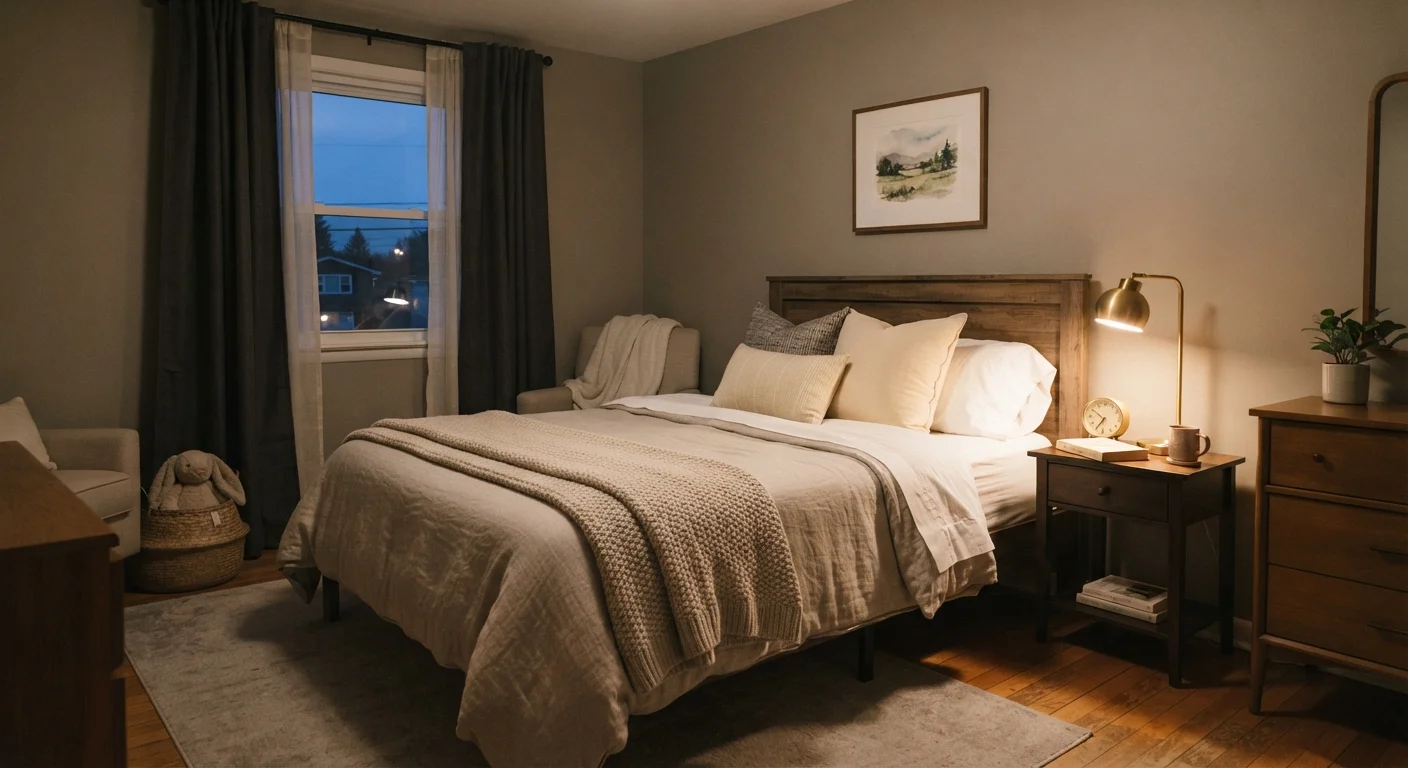
- Use blackout curtains or an eye mask to reduce light intrusion. Inexpensive options are widely available, and some families improvise with heavy curtains already in the home.
- Limit caffeine after noon for adults, and monitor caffeine in children's diets throughout the day.
- Create a short wind-down routine for children. A predictable sequence of bath, brushing teeth, and a few minutes of reading signals the brain that sleep is approaching.
Managing overall family stress also supports sleep. The free mental health resources available to American families can help address anxiety that surfaces at bedtime, particularly for children and teenagers.
Families who struggle with reactive healthcare patterns may find that consistent sleep is one of the lower-effort shifts described in breaking the reactive care cycle.
A simple habit that costs nothing
Write your family's target wake times on a piece of paper and put it somewhere visible for two weeks. Tracking the pattern by hand makes it easier to spot inconsistencies before they become habits. No app or device required.
When to talk to a doctor about sleep problems
Good sleep hygiene resolves many common sleep difficulties, but some problems require professional evaluation. Talk to a healthcare provider if any family member experiences:
- Loud or frequent snoring, gasping, or pauses in breathing during sleep (possible signs of sleep apnea)
- Excessive daytime sleepiness that persists despite adequate sleep time
- Insomnia that lasts more than three weeks
- Restless legs or frequent leg movements during sleep in a child or adult
- A child who consistently resists sleep or shows significant behavioral changes linked to sleep timing
Many preventive health visits covered by insurance include an opportunity to raise sleep concerns. Preventive care visits are often available at no out-of-pocket cost and are a practical place to start that conversation without an additional expense.
This article is for general informational purposes only and is not medical advice. Consult a qualified healthcare professional before making changes based on specific symptoms or health conditions.