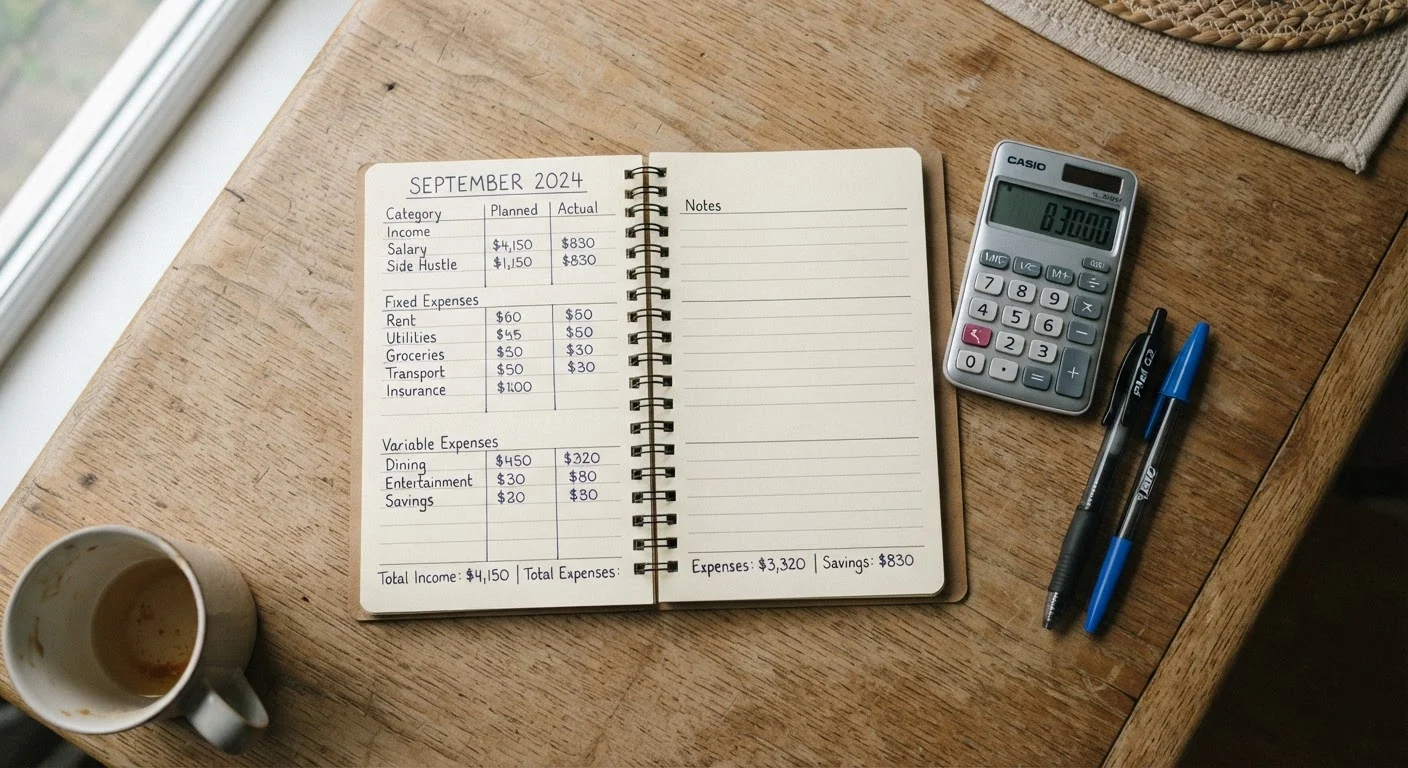


Why budgeting feels hard at first
Most families do not struggle with budgeting because they lack discipline. They struggle because no one taught them a clear starting point. Money conversations at home often focus on individual purchases rather than the overall system, so building one from scratch feels unfamiliar.
There is also a common misconception that a budget is a restriction. In practice, it is a plan. Writing down where money goes each month gives a household more control, not less, because decisions get made intentionally rather than by default.
The good news is that the core mechanics are straightforward. What follows covers the vocabulary, the first concrete actions, and the most common mistakes families make when they start.
Core concepts every household needs to know
Before choosing any budgeting method, it helps to understand a handful of terms that appear in nearly every financial planning conversation.
Net income
The money your household actually receives after taxes, health insurance premiums, and any other payroll deductions are taken out. This is the figure a budget is built on, not gross salary.
Fixed expense
A cost that stays the same amount each month, such as a mortgage payment or a car loan. These are easy to plan for because they do not change.
Variable expense
A cost that changes from month to month, such as groceries or electricity. Budgeting for these typically involves calculating an average from recent months.
Periodic expense
A cost that does not arrive every month but is predictable, such as an annual insurance premium or back-to-school shopping. Dividing the annual total by 12 converts it into a monthly budget line.
Budget surplus
What remains when your income is greater than your planned expenses for the month. A surplus can be directed toward savings, an emergency fund, or debt repayment.
Budget deficit
When planned or actual expenses exceed income for the month. A deficit means spending must be reduced, income increased, or savings drawn down.
One distinction that matters immediately is the difference between fixed and variable expenses. Fixed expenses, such as rent or a car payment, stay the same each month and are easy to plan for. Variable expenses, such as groceries or utilities, change from month to month and require averaging. A third category, periodic expenses, includes costs that arrive infrequently, such as car registration fees or school supplies. Many household budgets undercount periodic expenses, which is why unexpected costs feel like emergencies even when they are predictable.
Your first four steps
Rather than choosing a budgeting framework on day one, build a data foundation first. These four steps put you in a position to make informed choices.
- Write down all income sources. Include take-home pay (after taxes and deductions), any side income, and regular transfers such as child support. Use the actual deposited amount, not gross salary.
- Gather 30 days of real spending data. Pull bank and credit card statements from the past month. Categorize every transaction, even small ones. This is the most revealing step most families skip.
- Separate needs from wants. Housing, utilities, groceries, transportation, and minimum debt payments are needs. Subscriptions, dining out, and entertainment are wants. This separation is not permanent moral judgment; it shows where flexibility exists.
- Set a trial budget for one month. Assign a dollar amount to each category based on your actual data, not an aspirational number. A trial budget is expected to be imperfect; the point is to get a working version on paper.
Use last month's statements, not estimates
When gathering spending data, pull actual bank and credit card statements rather than trying to estimate from memory. Most people underestimate spending in variable categories by 20 to 30 percent when working from memory alone. Real numbers make the first budget draft far more usable.
For a more detailed walkthrough of this process, see the step-by-step monthly budget guide from our Smart Family Savings series.
Common pitfalls and how to avoid them
Several patterns trip up households that are new to budgeting.
Setting amounts based on what you wish you spent. If your grocery receipts consistently show $900 per month, budgeting $600 does not make the extra $300 disappear. It just creates a number you will routinely miss, which is discouraging enough to cause abandonment.
Forgetting periodic expenses. Annual, semi-annual, and quarterly bills need to be divided by 12 and included as a monthly line item. Car insurance paid every six months is still a monthly expense of one-sixth that amount.
Having no buffer. A budget with every dollar allocated to a named category leaves no room for genuine surprises. Most financial planners suggest keeping a small miscellaneous line, even $50 or $100, for costs that do not fit anywhere else.
Treating the first draft as final. A budget built on one month of data will need revision. Review it after month one, adjust categories that were consistently off, and treat refinement as normal rather than as failure.
Families managing variable income face an additional layer of complexity. The general approach is to build the spending plan around the lowest income month you reliably expect, and use above-average months to build a buffer or pay down debt.
Where to go from here
Once you have one month of real data and a working draft budget, the next decision is which framework to use going forward. Two of the most widely discussed options are zero-based budgeting, where every dollar of income is assigned a purpose, and the 50/30/20 rule, which splits income into broad categories by percentage. Both have real trade-offs depending on how variable your income is and how much detail you want to manage. The comparison of zero-based budgeting and the 50/30/20 rule walks through which households each approach suits.
If you prefer a tangible, low-tech system, the envelope budgeting method is worth examining. It uses physical or digital envelopes for each spending category and stops overspending mechanically rather than relying on willpower.
Budgeting also connects directly to specific spending areas. For families who want to apply these habits to travel, the family vacation planning guide shows how to set a trip budget before booking anything. For everyday household costs, the broader Frugal Family Living hub covers practical ideas across groceries, utilities, and lifestyle spending.
This article is for general informational and educational purposes only. It does not constitute personalised financial advice. Consult a qualified financial professional for guidance specific to your household's situation.