

Why coupon myths persist
Couponing has a complicated reputation. Television shows portrayed households stockpiling hundreds of products at near-zero cost, while skeptics dismiss coupons as traps designed to make you spend more. Neither picture is fully accurate, and the gap between them is where most families make spending mistakes.
The myths around couponing tend to stick because they contain a grain of truth. Coupons can save real money. They also can push shoppers toward unplanned purchases. Understanding which outcome you get depends on how you use them, not on coupons themselves.
For a broader look at spending patterns that quietly cost families money, see common grocery habits that drain the family budget. Many of those habits interact directly with coupon behavior.
Myth
Coupons always save you money on your grocery bill.
Fact
Coupons save money only when applied to purchases you planned to make at a price that beats the alternative.
A coupon for $1.50 off a $6 brand-name product still leaves you paying more than the $3 store-brand equivalent. Savings are real only when the discounted price is lower than what you would have paid for the item you already intended to buy. When a coupon changes what you buy rather than what you pay for a planned item, it functions as a marketing tool, not a savings tool.
Myth
Extreme couponing is a realistic strategy for most families.
Fact
Extreme couponing requires many hours per week and works best in specific geographic markets, making it impractical for most households.
The dramatic savings shown in media coverage depend on store doubling policies, regional chain rules, and the ability to buy in quantities that most families cannot store or use. A 2019 survey by CouponCabin found that the average American coupon user saves around $20 to $30 per month, a useful amount but far from the hundreds shown in television programming. Time is a real cost: if coupon research takes three hours to save $25, that math does not work for most working families.
Myth
Paper coupons are the most effective way to save.
Fact
Digital coupons and loyalty program pricing have surpassed paper clipping in reach and ease for most shoppers.
Sunday newspaper inserts were once the primary coupon channel, but grocery chain apps, manufacturer websites, and cashback platforms now deliver larger and more targeted discounts. Many stores also offer digital-exclusive prices that are not available to shoppers who skip the app. Paper coupons still exist and can still be useful, but treating them as the primary tool means missing a larger pool of available savings.
Myth
Stacking coupons is always allowed and always worth doing.
Fact
Stacking rules vary by retailer, and the time required to find stackable deals often exceeds the incremental savings.
Some stores allow one manufacturer coupon and one store coupon on the same item. Others do not. Policies change, and cashiers are not always aware of current rules, which creates friction at checkout. For everyday shoppers, the marginal gain from stacking on a single item is usually small. The strategy makes more sense for higher-cost household categories than for a $2 can of soup.
Myth
Using a coupon means you got a deal.
Fact
A coupon confirms a transaction occurred at a discount, not that the purchase was the financially sound choice.
Retailers and manufacturers issue coupons to move specific products, introduce new items, and build brand loyalty. None of those goals are identical to helping you spend less overall. If a coupon prompts you to buy something outside your budget or in a quantity you cannot use, your total spending goes up even though the per-unit price went down. The relevant comparison is always against what you would have spent without the coupon, on the items you actually needed. This connects directly to what frugality actually means: spending less on what you need, not spending on things you do not need at a lower price.
How to make couponing work in practice
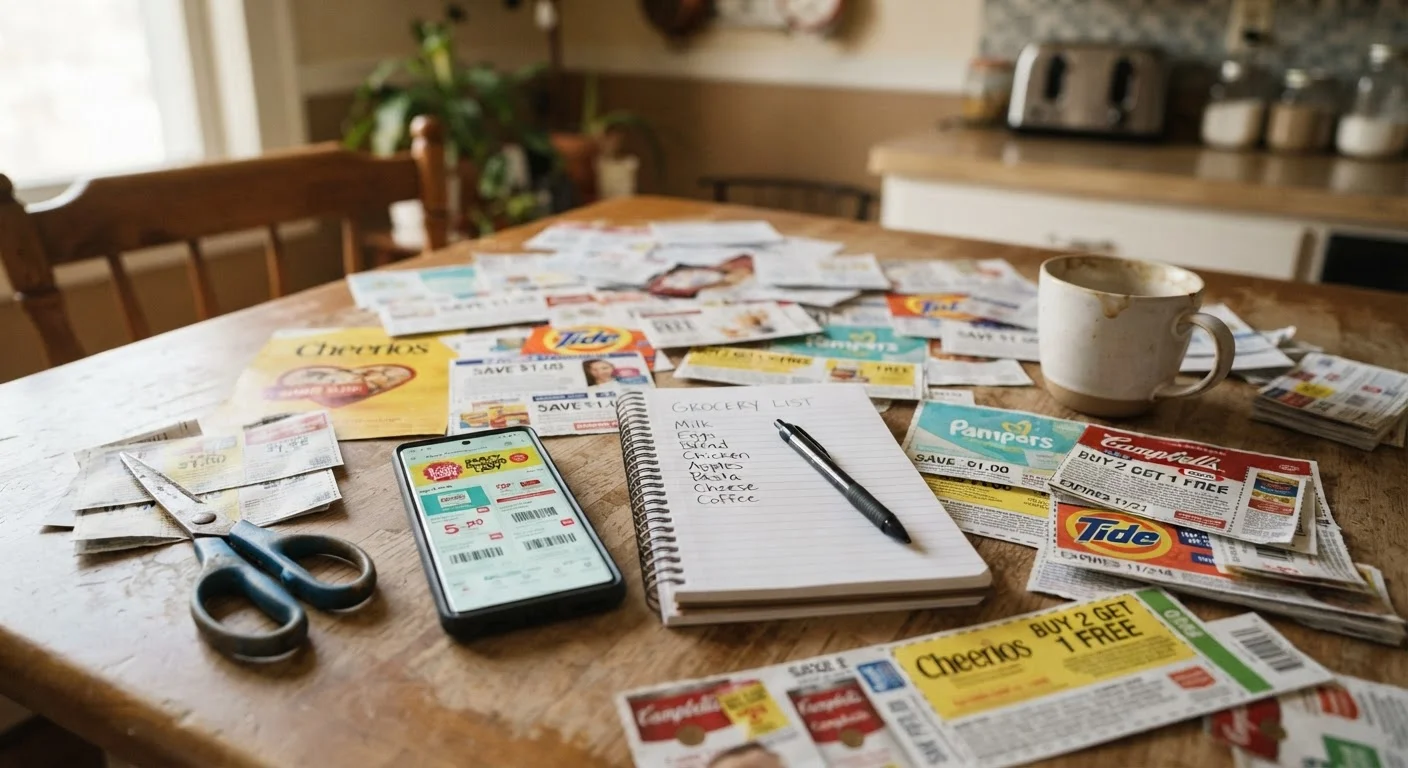
The families who see consistent savings from coupons follow a few concrete habits. They start with a shopping list based on what they actually need, then search for coupons on those specific items afterward. This sequence matters. Searching for deals first and building a list around them reverses the logic and leads to spending on things you would not have bought otherwise.
Digital tools have lowered the time cost significantly. Most major grocery chains have loyalty apps that apply discounts automatically at checkout. Pairing those with manufacturer coupons, when the store allows stacking, can produce meaningful reductions on staples. The bulk buying decision follows similar logic: a lower unit price only helps if you will actually use the product before it expires or goes to waste.
Couponing also fits better in some budget categories than others. Shelf-stable pantry goods, household cleaners, and personal care products are good candidates. Fresh produce and perishables rarely have coupons worth chasing, and spending time hunting deals on low-cost items rarely produces returns that justify the effort.
For families building a full spending strategy, couponing is one tactic among several. The Frugal Family Living hub covers complementary approaches, and the broader piece on money myths that hold families back puts coupon culture in context alongside other common financial misconceptions.
Track your actual savings, not just the receipt total
Grocery receipts often display a "you saved" total that counts loyalty card pricing, manufacturer coupons, and promotional discounts together. That number does not tell you whether you spent less than your planned budget. The only figure that matters for your household is whether your total grocery spend stayed within the amount you allocated. Keeping a simple monthly log of budgeted versus actual grocery spending gives you real data on whether your coupon habits are working.